
 Posted by
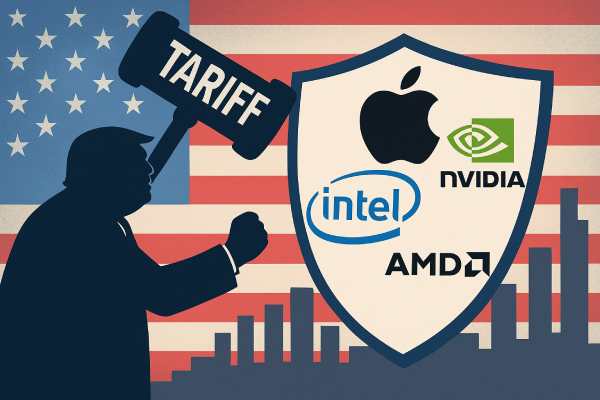
 Big tech companies are employing a range of unique deal-making tactics to protect their business interests amid Trump administration’s renewed trade politics and aggressive tariffs. These big tech companies are devising new plans and arrangements to stay in the US administration’s good books and evade tariffs.
From government equity stakes and revenue-sharing to fresh investments, tariff exemptions to targeted discounts, the U.S. tech industry has quickly re-aligned itself with President Donald Trump’s unpredictable nature and tarrif-led policies, choosing obedience over confrontation. The U.S. tech industry appears now to be a big fan of President Trump.
Intel stake deal with Trump administration
The Trump administration recently acquired a 9.9% passive equity stake in Intel, converting $8.9 billion in unpaid CHIPS Act grants into shares. However, Intel confirmed that the stake sale would not come with board rights or influence over company decisions.
“Intel is deeply committed to ensuring the world’s most advanced technologies are American made,” said Lip-Bu Tan, Intel CEO. “President Trump’s focus on U.S. chip manufacturing is driving historic investments in a vital industry that is integral to the country’s economic and national security.”
“As more companies look to invest in America, this administration remains committed to reinforcing our country’s dominance in artificial intelligence while strengthening our national security,” Howard Lutnick, Secretary of Commerce, commented on the deal between Intel and US administration.
The response from corporate leaders suggests that big tech companies have, at least publicly, aligned themselves with the Trump administration’s agenda. Rather than take individual positions that might invite penalties or political backlash, many firms appear to be coordinating their stance, choosing cooperation over confrontation.
“Intel’s continued investment in strengthening the U.S. semiconductor supply chain, supported by President Trump’s bold strategy to rebuild this critical industry on American soil, will benefit the country and broader technology ecosystem for years to come,” said Satya Nadella, Chairman and CEO of Microsoft.
“It’s great to see Intel and the Trump administration working together to advance U.S. technology and manufacturing leadership,” said Michael Dell, Chairman and CEO of Dell Technologies.
He added, “Dell fully supports these shared priorities and we look forward to bringing a new generation of products to market powered by American-designed and manufactured Intel chips.”
HP President and CEO Enrique Lores called the deal between Intel and Trump administration as a defining moment for great American companies to the world in cutting-edge technologies.
Likewise, AWS CEO Matt Garman, applaued the Trump administration’s efforts to usher in a new era of American innovation in partnership with American companies. Interestingly, these mentioned companies are customers of Intel.
However, these developments show how these big tech companies are trying to deal with unpredicitive nature of President Trump. Firstly, they have aligned themselves with the Trump administration’s tarrif strategy and then found ways to secure their business interests both within the United States and overseas.
Apple deepens U.S. investment, secures India tariff exemption
Apple has announced a new $100 billion commitment to America, significantly accelerating its U.S. investment to a total of $600 billion over the next four years. This includes the launch of the American Manufacturing Program, dedicated to bringing more of Apple’s supply chain and advanced manufacturing to the United States.
“We’re proud to increase our investments across the United States to $600 billion over four years and launch our new American Manufacturing Program,” Tim Cook, Apple CEO said about the company’s investment in America.
Cook said the initiative would expand Apple’s collaboration with 10 U.S. companies that supply components for Apple products sold worldwide, He appreciated the President’s support in the effort. But Apple’s announcement coincided with the Trump administration’s 25% tariffs on electronics imported from India.
Later, the Trump administration increased tariffs on imports from India by another 25%, bringing the total to 50%. This makes very difficult for American companies and businesses to import products from India.
The Trump administration in recent months has been openly targetting India with tarriffs for purchasing crude oil from Russia. Washington believes the India is helping the Russian economy sustain against sanctions and fueling the the on-going Russia-Ukraine conflict.
However, the Trump administration granted exemptions to iPhones assembled by Foxconn and Tata in Tamil Nadu and Karnataka, shielding nearly a third of Apple’s global iPhone production from trade disruption. Industry watchers believe that Apple’s investment in the U.S. is a smart balancing act between overseas manufacturing plans and domestic policy alignment.
NVIDIA and AMD agree to revenue-sharing
NVIDIA and AMD reportedly have agreed to a revenue-sharing deal with the Trump administration, sharing 15% of revenues from China sales. This indicates how China remains a significant market for American tech companies despite export restrictions.
The deals offer a short-term reprieve for both firms while satisfying administration goals of tighter oversight on technology transfers. However, there has been no official statements from both the companies on revenue-sharing with Trump administration. More so, investors and shareholders of NVIDIA and AMD are believed to be unhappy with this new arragement.
Oracle’s new discounts tactics
Unlike other big tech companies, Oracle has taken a different approach. The company has introduced targeted discounts for U.S. government agencies adopting its cloud services.
“The move aims to ease cost mid tariff-related challenges while helping federal clients modernise their infrastructure,” Oracle’s EVP of Government, Defence and Intelligence, Kim Lynch wrote in a company blog post.
According to Lyn, the (discount) strategy also positions Oracle to retain key government contracts at a time when cost-efficiency and compliance with federal priorities have become central to procurement decisions.
It is likely that other big tech companies with large cloud operations, such as Google, AWS and Microsoft Azure, may consider similar discount strategies as tariff uncertainties continue to affect pricing and deployment models.
Legitimancy concerns and the future of free enterprise
While these arrangements provide strategic relief, they also raise questions about the long-term implications for U.S. economic policy. Legal and economic experts have expressed concerns that such deals may blur the boundaries between public policy and private enterprise.
Government equity stakes, tariff carve-outs and licensing fees tied to exports, challenge the traditional principle that markets, not the state, allocate capital and set business direction. Some argue this shift could distort competition or encourage a case-by-case deal-making approach to regulation.
As similar arrangements gain traction, scrutiny is likely to grow around their legitimacy, transparency, and broader market impact.
For now, big tech companies appear to have responded swiftly and smartly to the Trump administration’s tariff-pressure tactics. These major companies are adhering to and cooperating with the administration through unique and company-specific agreements and deals.
Whether these arrangements will be short or long-term remains difficult to predict. The impact of these arrangements on overall business performance will only become clear after a couple of quarters.
The U.S. tech industry worth around $1.6 trillion, with forecasts predicting continued growth, as per estimates. In 2023, the sector’s contribution to the U.S. gross domestic product (GDP) was nearly $2 trillion, accounting for about 8.9% of the total GDP. The tech sector employed approximately 9.6 million people in 2023.
Compared to other sectors, few can match the tech industry’s scale and resilience, Probably, this puts the tech sector in better positioned to respond to the challenges posed by the Trump administration’s tariff-led trade policies.
(Illustration created with AI assistance)