
 Posted by
 As artificial intelligence systems become smarter and more powerful, there’s an ongoing AI race that is advancing faster than initially expected. Recent cases of AI misuse and global warnings in past, and the restricted rollout of advanced AI models have raised fresh concerns about whether the tech industry’s AI race is moving too faster than it can safely manage.
The global race to develop advanced AI has entered in a more complex phase today. Companies such as Anthropic, OpenAI, and Google are pushing systems beyond traditional automation into areas that involve reasoning, decision making, and increasing levels of autonomy. For enterprises and policymakers, this shift is no longer just about innovation and automation. But is also about its control, risk, governance and the ability to manage systems that are becoming more independent by design.
Concerns around misuse of AI are not new. In 2021, the United Nations Counter-Terrorism Centre and the United Nations Interregional Crime and Justice Research Institute released a report titled Algorithms and Terrorism: The Malicious Use of Artificial Intelligence for Terrorist Purposes. The possible use of AI for propaganda, recruitment, and operational planning, the report outlined. And it warned that emerging technologies could lower barriers and enable more sophisticated threats.
However, a recent incident suggest those concerns have started to materialise. Indian National Investigation Agency (NIA)’s investigation suggest that individuals accused in Delhi’s Red Fort bomb blast case allegedly used AI platforms alongside online videos and internet resources to research and develop improvised explosive devices (IED).
Investigators, according to media described the process as approaching a laboratory level of precision, with digital tools used to refine materials, methods, and execution strategies. This highlights how accessible technologies can be combined to make attacks more precise and sophisticated.
For enterprises, this signals a broader shift. Artificial intelligence does not need to replace expertise to pose risk. It can enhance it. Even in its current form, AI can reduce the time and effort required to plan and execute complex actions. As models become more capable, they will increasingly amplify this effect.
At the same time, the direction of AI development is moving towards autonomous systems. Developers design these systems to learn continuously and act with minimal oversight, while enterprises increasingly deploy them to manage operations, infrastructure, and workflows.
This transition from assistive tools to autonomous systems introduces new challenges. Systems that can act independently can also be misused independently. If compromised or repurposed, they could enable continuous, adaptive activity that is harder to detect and contain.
The cautious approach taken by Anthropic with its advanced model, Claude Mythos, reflects these concerns. Interestingly, the company has kept the model private, sharing it only with a limited group of organisations, with access granted to roughly forty entities capable of managing it responsibly.
The rationale lies in the model’s capabilities. Mythos can analyse complex systems, identify vulnerabilities, and simulate multi step scenarios at scale. In controlled environments, organisations can use this to identify and fix weaknesses before exploitation, while in less controlled settings, malicious actors could use it to exploit those same vulnerabilities.
This dual use nature is becoming a defining characteristic of advanced AI. Technologies that deliver operational efficiency and security benefits can also introduce new risk vectors if deployed without sufficient safeguards.
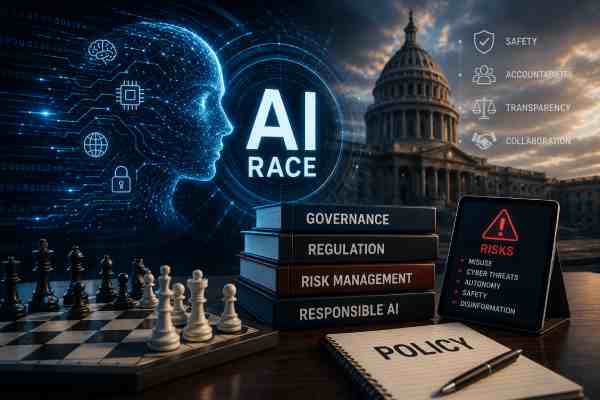
Despite these signals, the pace of AI development remains high. Competitive pressure among technology companies and nations continues to prioritise speed, often ahead of governance frameworks. For enterprises, this creates an environment where innovation is rapid, but risk visibility and mitigation strategies may lag behind.
Addressing this gap will require coordinated action. Governments and industry stakeholders need to establish clearer policies around the development and deployment of advanced AI systems. This includes controlled access to high risk models, stronger pre deployment testing, and accountability frameworks that define responsibility across the AI lifecycle.
Artificial intelligence is inherently global in its impact. Any vulnerability found in one system can impact others globally, and actors can repurpose legitimate tools for malicious use elsewhere. This makes collaboration between governments, enterprises, and technology providers essential.
Slowing the pace of AI development does not imply restricting innovation. But it highlights the need to align technological progress with effective risk management and governance. The signals are already visible, from early warnings in global reports to real world misuse cases and the cautious handling of advanced models.
For the technology industry, the priority now is to ensure that AI systems remain secure, accountable, and controllable. The decisions made at this stage will shape not only how AI is deployed, but how safely it can be integrated into critical systems in the years ahead.